

Special Edition: Navigating Your Pathway to Canada (PNP or EE?)

by Daniel Peimbert | Mar 29, 2024 | Immigration, PNP, Tips

If your work permit is approaching its expiry date while your Permanent Residence (PR) application sits in Immigration, Refugees and Citizenship Canada’s (IRCC) processing queue, you are likely feeling the pressure. Historically, applying for a Bridging Open Work Permit (BOWP) or a work permit extension required one crucial document: an official Acknowledgement of Receipt (AOR) proving that IRCC passed your PR file through its initial Section 10 (R10) completeness check.
Without an AOR, thousands of applicants faced the immediate risk of losing their legal authorization to work in Canada.
To address these administrative processing delays, IRCC issued Operational Bulletin 699 (OB 699). Under this temporary measure, eligible Provincial Nominee Program (PNP) applicants physically present in Canada can extend their work authorization using alternative proof of PR submission—without waiting for an AOR.


Policy Snapshot: Operational Bulletin 699

Feature Key Details
Official Reference IRCC Operational Bulletin 699
Effective Period In effect from June 9, 2026 through December 31, 2026 (unless revoked earlier by IRCC)
Location Requirement Applicant must be physically present in Canada
Eligible PR Streams In-Canada Base (non-Express Entry) PNP and Express Entry-aligned PNP streams
Accepted Alternative Proof Automated PR Portal Submission Confirmation Email + Official IRCC Fee Receipt

Which Work Permits Are Covered Under This Policy?

This temporary measure allows eligible in-Canada applicants to apply for three specific work permit streams without providing an AOR:
  • Bridging Open Work Permit (BOWP / Category A75): Enables eligible PNP nominees to maintain open work authorization for any employer while IRCC processes their PR application.
  • Employer-Specific PNP Work Permit (Category T13): Allows nominees to renew their closed work permit with their nominating employer, even if their provincial nomination certificate has expired due to IRCC processing backlogs.
  • Spousal Open Work Permit (SOWP): Permits the accompanying spouse or common-law partner of the principal PNP applicant to extend or obtain an open work permit concurrently.

Required Alternative Documentation

Because you cannot provide a formal AOR letter, you must upload alternative evidence proving your PR application is submitted and pending in the IRCC portal:
PR Portal Submission Confirmation: A copy of the automated email receipt generated immediately upon submitting your electronic PR application through the IRCC Permanent Residence Portal.
Official IRCC Proof of Payment: The official fee receipt confirming that all applicable PR processing fees and the Right of Permanent Residence Fee (RPRF) have been paid in full.
Mandatory IRCC Requirement: If IRCC has already issued your official AOR letter prior to submitting your work permit extension, you must submit the actual AOR letter. The alternative proof mechanism is strictly reserved for applicants whose AOR has not yet been generated.

Critical Action Steps: Safeguarding Your Status

1. Apply BEFORE Your Current Work Permit Expires

Timing is paramount under the Immigration and Refugee Protection Regulations (IRPR). Submitting your work permit application before your existing permit expires automatically grants you maintained status (formerly referred to as implied status). This status legally authorizes you to continue working in Canada under your existing conditions while IRCC renders a decision.


2. Update Your Application via IRCC Webform

When IRCC completes the R10 completeness check and issues your formal AOR letter, you must immediately upload a copy of that letter to your pending work permit file via the IRCC Webform to complete the application record.


3. Verify Complete PR Documentation

Relying on alternative proof allows you to file the work permit application, but it does not guarantee PR completeness. If IRCC later determines during the R10 check that your PR application is incomplete, the PR file will be rejected and returned. Consequently, the underlying foundation for your work permit extension will be invalidated, leading to a refusal.


Common Pitfalls That Lead to Refusal or Status Loss

  • Failing to File Before Expiry: Maintained status only applies if IRCC receives your work permit application prior to midnight UTC on the date your current permit expires. Submitting even one day late results in loss of legal status and requires a restoration application.
  • Applying from Outside Canada: Operational Bulletin 699 applies strictly to candidates physically present inside Canada. Applicants outside Canada must follow standard entry and work permit processing rules.
  • Omitting the Official Fee Receipt: Submitting the portal email confirmation without the official IRCC receipt showing full payment of processing fees will result in the immediate rejection of your work permit application.
  • Submitting Alternative Proof When an AOR Exists: If an AOR was already issued in your portal or sent via email, attempting to use alternative submission proof instead of the formal letter violates policy guidelines.

Retain Professional Advisory for Your Application

Navigating temporary public policies, maintaining legal work authorization, and meeting strict regulatory deadlines require precise execution. A single missing document or miscalculated timeline can jeopardize your ability to remain and work legally in Canada.
Whether you require a comprehensive review of your work permit application under Operational Bulletin 699, verification of your PR portal documents, or guidance on maintaining your status, our team is available to assist.


👉 Schedule a Consultation with an RCIC Today or contact our office to review your case and ensure your continuous authorization to work in Canada.

This special edition of our monthly newsletter delves deep into the heart of Canadian immigration pathways: the Provincial Nominee Program (PNP) versus Express Entry. With Canada’s welcoming stance on immigration, selecting the right path is crucial for a smooth transition to your new home.

Understanding Express Entry: Your Fast Track to Canadian Living

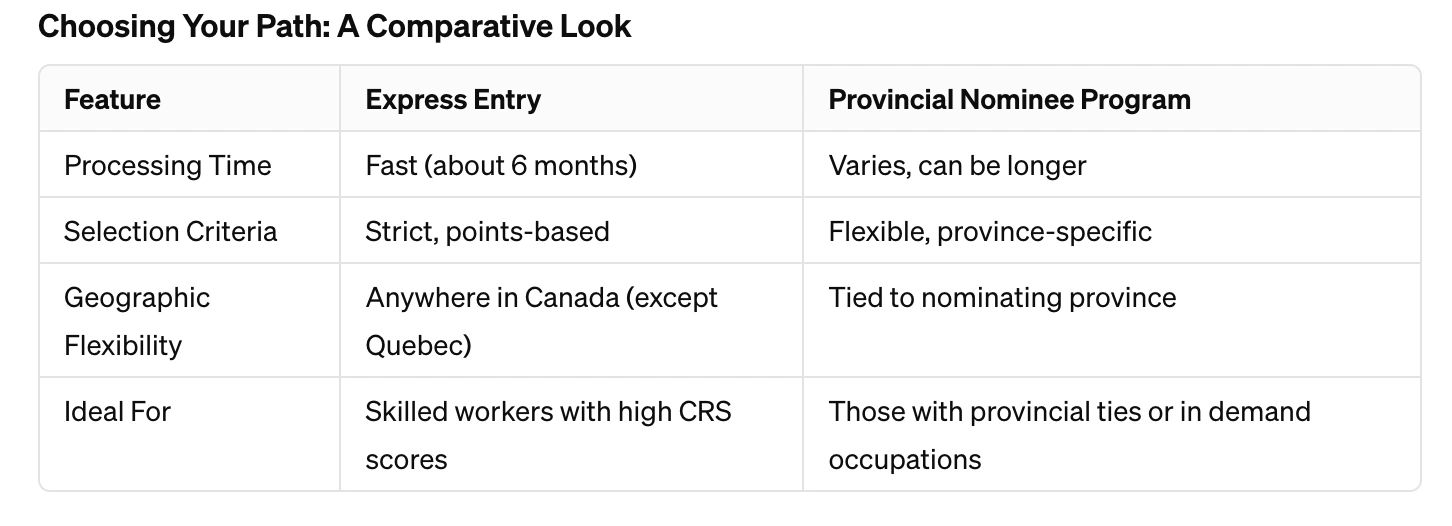
Express Entry is Canada’s flagship immigration system, designed for skilled workers seeking a fast track to permanent residency. It’s a points-based system that evaluates candidates based on age, education, work experience, and language proficiency in English or French. Here’s why Express Entry might be your golden ticket:

  • Fast Processing Times: Most applications are processed within six months. (keep in mind that there is a backlog currently, and applications are taking longer)
  • Federal Program: Allows you to live and work in Canada except Quebec.
  • Comprehensive Ranking System (CRS): Higher scores increase your chances of receiving an Invitation to Apply (ITA) for permanent residency.
  • Most recent round of invitations:

General (March 25, 2024):

Number of invitations issued: 1,980

CRS score of lowest-ranked candidate invited: 524

Ideal candidates: Due to the current high scores, this program is better suited for international graduates with Canadian work experience, as well as foreign workers in Canada with Canadian work experience in:

  1. Healthcare occupations
  2. Science, Technology, Engineering and Math (STEM) occupations
  3. Trade occupations
  4. Transport occupations
  5. Agriculture and agri-food occupations

In addition, candidates must have strong language skills in English or French. (Having a CLB of at least 5 in one of Canada’s second official languages can boost your score and make you more competitive in the pool.) Lastly, the higher your education, the better your score. Higher education degrees, such as a master’s degree or Ph.D., can make a big difference.

Provincial Nominee Program (PNP): Your Localized Route to Canadian Residency

If you have a particular province or territory in mind, the PNP could be your ideal pathway. Provinces select immigrants based on their specific economic needs, which means requirements and processes vary greatly. Here’s the scoop on PNP:

  • Targeted Immigration: Tailored to meet the specific needs of Canada’s provinces and territories.
  • Flexible Requirements: Often more relaxed than Express Entry regarding work experience, education, and language proficiency.
  • Direct Pathway to Permanent Residency: Successful nominees receive a provincial nomination, which can significantly boost an Express Entry profile or lead directly to permanent residency.

Who It’s For: Those with connections to specific provinces (through family, job offers, or education) or those in occupations highly demanded by a province.
Making Your Decision

Selecting Express Entry and PNP depends on your unique profile and immigration goals. Consider the following before making your choice:

  • Assess Your Qualifications: Use online tools to estimate your CRS score for Express Entry. Explore provincial requirements for PNP.
  • Consider Your Long-Term Goals: Where in Canada do you see yourself thriving? Are you flexible on location?
  • Seek Professional Advice: Licensed immigration consultants can provide personalized guidance based on the latest policies.

If you want to explore your options, book your consultation.

Stay Informed, Stay Inspired

As Canada continues to look for the best immigrants, staying informed about immigration policies is key to a successful process.

Warm regards,

Daniel Peimbert, RCIC

Founder & CEO of Great Start Canada Immigration

Regulated Canadian Immigration Consultant – R530387

Member of the Canadian Association of Professional Immigration Consultants (CAPIC)

Licensed Foreign Worker Recruiter in Manitoba

Commissioner for Oaths in Manitoba
Found this helpful? Share it:

GSC